Self-hosted. On your SIEM, in your perimeter.

A SOC that remembers.And proves it.

Warlog triages your alerts, investigates with evidence, and puts every dangerous action behind a human signature. What your team decides comes back on the next alert. What the platform did, you can verify without it.

30 minutes. A full attack, in the real console. No slides.

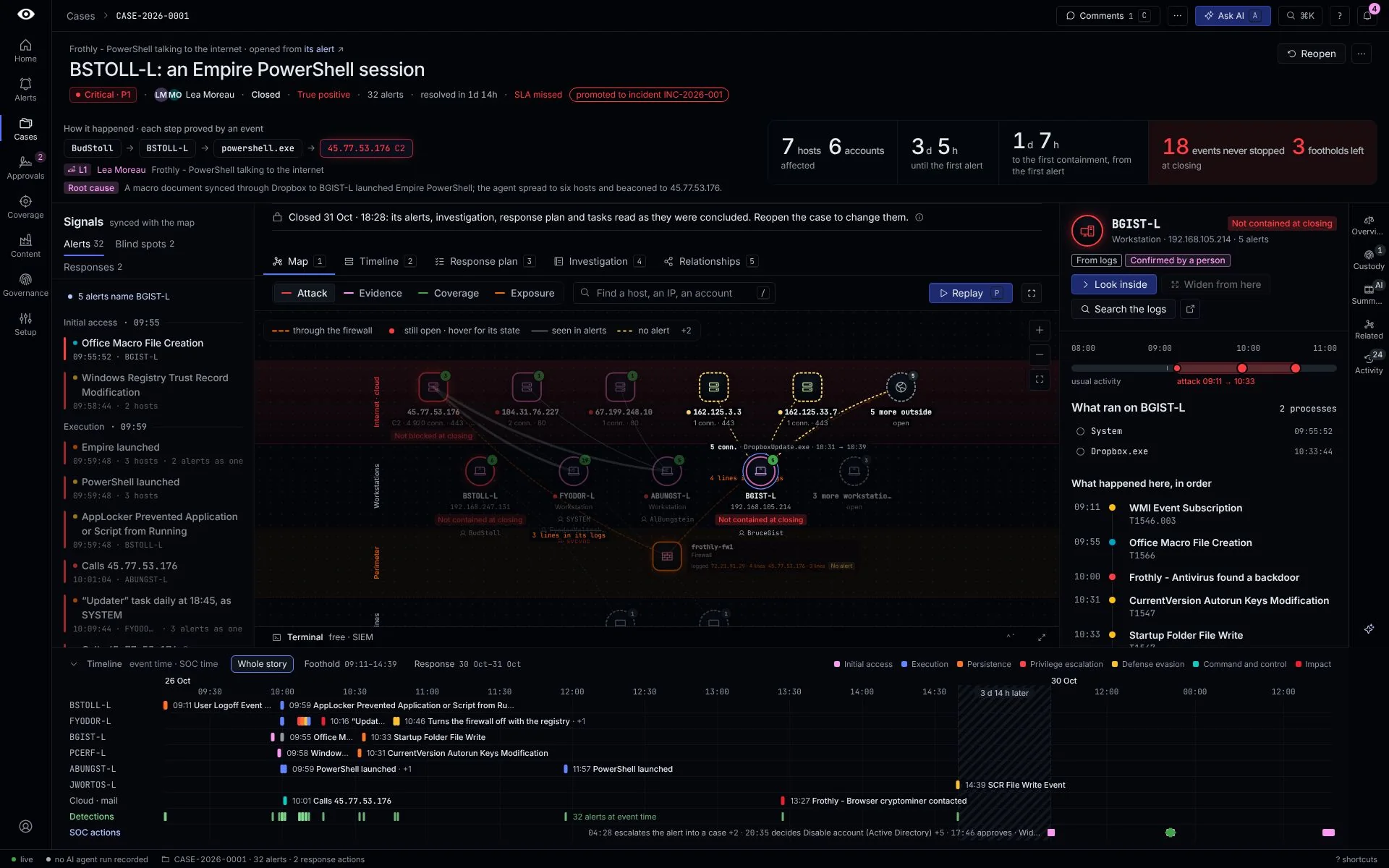
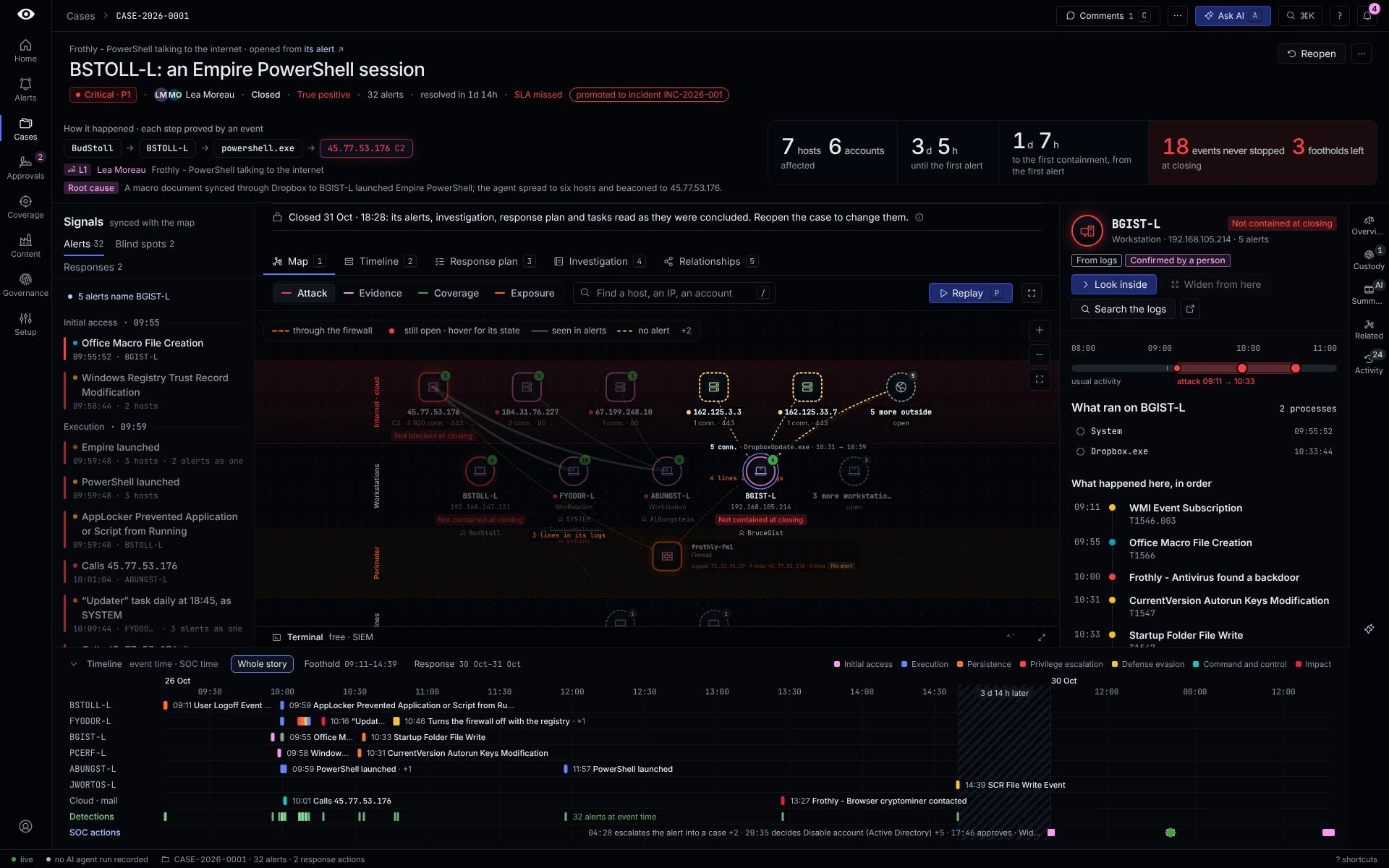
The Warlog console on a closed case: how the attack happened, the map of hosts by zone, and the whole story host by host.
Keeps your SIEMSelf-hostedAir-gap readySigned audit trailOpen spec, Apache 2.0

On Tuesday, your analyst spends three hours untangling a PowerShell case. On Thursday, the same family fires and a colleague starts from zero. Your tools saw the attack. Nobody kept what you learned.

The Warlog console on a closed case.

The memory

Decide once. It comes back on the next alert.

Tuesday

Your analyst closes an alert.

Service principal crm-sync calling Graph from an unknown ASNidentity · splunk · 09:14Benign · closed by Lea Moreau
crm-sync runs month-end billing. Revoke its tokens, do not disable it.
Thursday

The next one opens with it.

Service principal crm-sync calling Graph from an unknown ASNidentity · splunk · 11:02New
Precedent · same rule · closed 2 d ago by Lea Moreaucrm-sync runs month-end billing. Revoke its tokens, do not disable it.
When your team is ready

Approved, it becomes a rule.

A closed case can propose an automation rule.exact on technique, asset class, action, sourceNothing runs until a person approves it
suggested → active → disabled, expired or replaced

Illustration of the precedent panel and of a rule's life. Everything else on this page is the real console.

The console

What your team sees on Monday morning.

Investigation

Every answer comes with its evidence.

The AI drafts each step from what its searches found, and shows how many events each one brought back. What it pulls from the logs stays tied to the step that read it. The query and the raw answer are one click away. The verdict stays with your analyst.
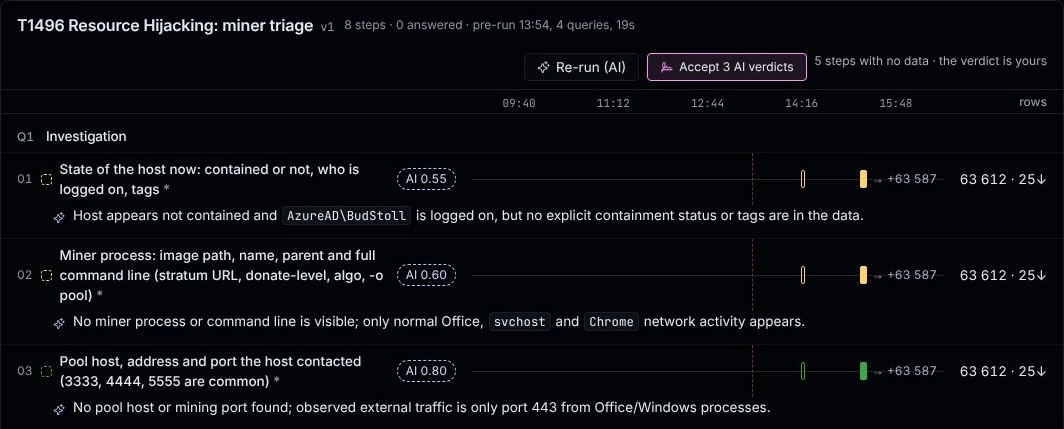
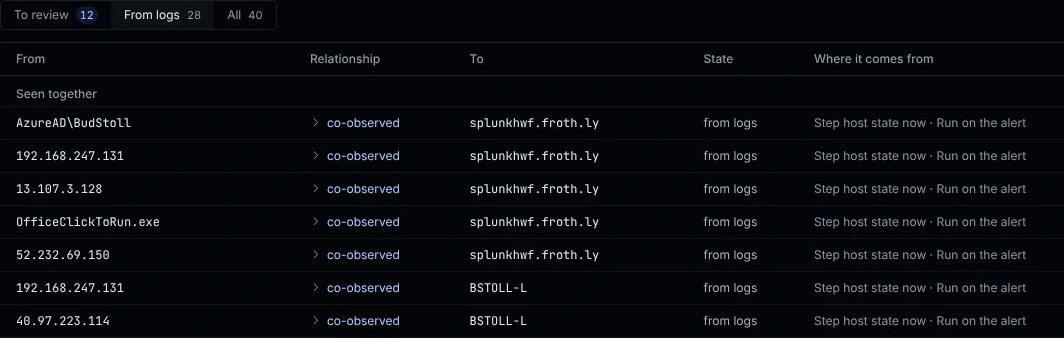
An investigation of 8 searches: each step with its AI reading, its timeline of events and its row count, 63,612 on the first steps.What the logs put together on the same alert: addresses, processes and accounts seen with a host, each row tied to the step that read it.
Priority

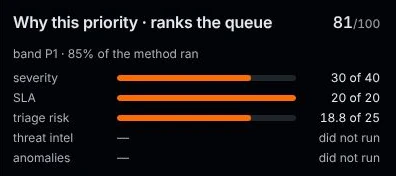
Every score, line by line.

What did not run says so.

A priority of 81 out of 100 broken down: severity, SLA, triage risk, and threat intel and anomalies marked did not run.
Triage

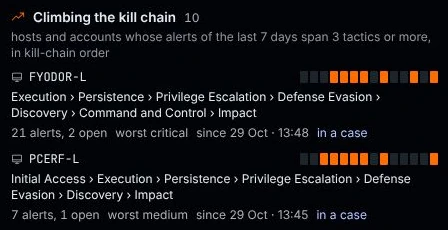
See who is climbing the kill chain.

Across the whole environment, before anyone opens a row.

Hosts climbing the kill chain, with the tactics each one has reached.
Coverage

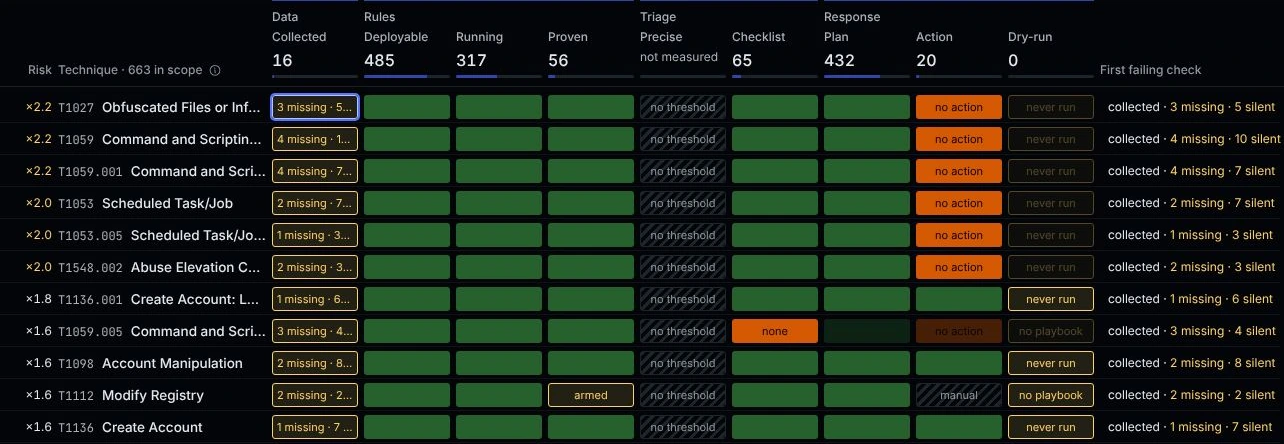
Find out exactly where your detection breaks.

Nine checks on every technique, from does the data arrive to does the playbook run, each counted on its own. On this lab the sources have gone quiet, and the first column says so before anyone asks.

663techniques in scope
485have a rule your SIEM can run
317have a rule running on it
56have a rule that matched live data
432have a plan to contain them

Frothly lab, snapshot of 3 November. Each check counted on its own: only 16 of the 663 have their data arriving.

Coverage matrix: techniques ranked by risk against nine checks, with the count of techniques passing each check and the first check each one fails.
Response

Fast on what is safe. Signed on what is dangerous.

Safe and reversible steps run on their own. Dangerous ones wait for an approver.

Playbook steps with their connector and risk: dangerous steps wait for an approver.
Approvals

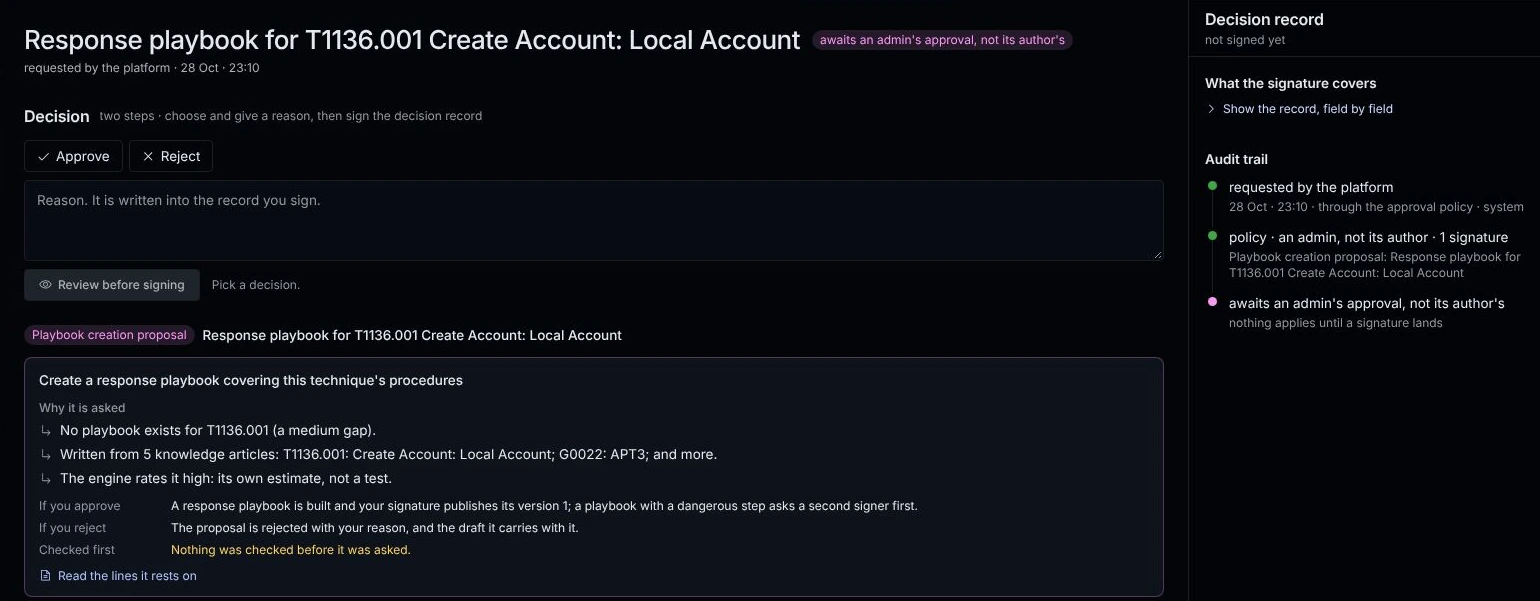
The AI proposes. Your team signs.

Nothing applies until a signature lands, and an author never approves their own work. Each request says why it is asked, what approving does, what rejecting does, and what was checked first.

A proposed playbook awaiting an admin, not its author: approve or reject with a reason, why it is asked, what each choice does, and the audit trail so far.
AI gateway

Your AI agents, on a short leash.

Every model call checked against your policy, its cost attributed to a case or an alert. Agents attested, budgets that refuse, secrets and injections caught in both directions.

$0.26AI cost of one 32-alert incident, 138 model calls
76%of 732 model calls served from the cache
$7.72saved by the cache in 7 days, for $2.75 spent
11AI agents on the list, 7 of them trusted

Frothly lab, the 7 days to 3 November.

AI agents with their calls and trust level, and the ladder they sit on: trusted, monitored, flagged, blocked.AI cost attributed to one case, and cache hits by type of call.
Don't take our word for it

Sign it. Then try to break it.

This is not a video. Approve a dangerous action, watch it get signed phase by phase, then tamper with the record. Your browser does the math.

Waits for an approver

Disable user account

AzureAD\FyodorMalteskesko
Risk
dangerous
Connector
Active Directory
Approval
senior
Signed by you. It goes on the record.
audit trail · re-checked from the first entryno entry yet
Nothing runs until a person signs.
Real HMAC-SHA256, computed by your browser right now on a sample secret. Same construction as warlog_spec.audit_chain.compute_signature, and on your own deployment the open verifier does this without Warlog: python -m warlog_spec.verify audit.jsonl --secret-file tenant.key
The numbers

If we did not measure it, we do not show it.

A figure the platform cannot back reads not measured, and a guard in the code refuses a score that cannot say so. Your CISO can screenshot any of it.

SLA compliance, no deadline set100%not measured
False positives, nobody triaged0%not measured
Time to detect, no sample0 snot measured
The difference

Not another SOAR. Not another black-box AI SOC.

SOARAutonomous AI SOCWarlog
Who decides a dangerous actionThe playbookThe model's confidenceA named person, who signs
What happens to the last decisionLost in a ticketReprocessed from scratchIt comes back on the next alert
What backs a numberA dashboardA confidence scoreA measure, or "not measured"
What you hand your auditorLogs to take on faithA narrativeA signed chain, verifiable without Warlog
Where your data livesDepends on the vendorOften the vendor's cloudIn your perimeter, air-gap possible
Your stack

Keep everything you already run.

Warlog sits next to your stack, inside your perimeter. No shared SaaS, no pooled telemetry. No SIEM at all? The whole loop runs on its own evidence lake.

SplunkElasticMicrosoft SentinelCrowdStrikeSentinelOneMicrosoft DefenderPalo Alto PAN-OSFortinetCiscoZscalerOktaActive DirectoryMicrosoft GraphAWS IAMProofpointOpenAIAnthropicGeminiDeepSeekLocal modelsSplunkElasticMicrosoft SentinelCrowdStrikeSentinelOneMicrosoft DefenderPalo Alto PAN-OSFortinetCiscoZscalerOktaActive DirectoryMicrosoft GraphAWS IAMProofpointOpenAIAnthropicGeminiDeepSeekLocal models
MITRE ATT&CKD3FENDSigmaOCSFSTIXOASIS CACAONIS2DORASOC 2NIST CSFISO 27001ANSSI PGSSI-SEvidence lakeLocal modelsAir-gappedYour keysMITRE ATT&CKD3FENDSigmaOCSFSTIXOASIS CACAONIS2DORASOC 2NIST CSFISO 27001ANSSI PGSSI-SEvidence lakeLocal modelsAir-gappedYour keys
Under the hood

For the engineer who will check everything.

Open any card. The contract is public, the schemas are strict, and your records stay readable even if Warlog disappears.

L3 · FRONTLINEDecision Surface
AI drafts. Humans decide. Control stays explicit.
L2 · DOCTRINEAdaptive Memory
Approved decisions compound. Verdicts, who reached them, and why come back when the same rule or the same subject returns.
L1 · FABRICSafe Execution
Actions stay bounded before delivery. Typed, dry-run first, signed at every phase.
L0 · SUBSTRATEShared Model
The stack resolves to one model. Signals, actions, and proof land on shared objects.
CANONOne incident shapeAlert, action, connector, and KB point to the same model.Shared model
OUTBOXSafe deliveryActions run once, in order, with retries that stay safe.Execution guarantee
PROOFSigned historyWho approved what, why, and what happened next.Audit guarantee
FAQ

Straight answers.

Do I have to replace my SIEM?
No. Warlog works on Splunk, Elastic, or Sentinel. No SIEM at all? The whole loop runs on its own evidence lake.
Does anything leave my network?
Warlog runs inside your perimeter, with your keys. With a local model, nothing leaves the box. With a cloud model, only the calls you allow go out, through the AI gateway, metered and recorded.
Does Warlog take autonomous or destructive actions?
Not by default, and never destructively. The machine proposes. It acts alone only under an automation rule a person ratified, exact on its scope, and those rules escalate, group, suppress, or close as benign. Safe and reversible playbook steps run unattended. Dangerous ones wait for an approver: a requirement derived from the action's type, not from a UI toggle.
Can I try it without risk?
Warlog can run beside your SOC in shadow mode: it records its verdicts and what it would have done, acts on nothing, and shows nothing to your analysts.
What will I see in the demo?
The real console, on a full attack from a public dataset: first alert, investigation, case, response, signed record, report. Thirty minutes, and your questions drive it.
Is Warlog open source?
The warlog-spec contract is open source under Apache 2.0 and free to use in any language. Warlog OS, the runtime, is commercial and operator-led.
How is it different from SOAR or an autonomous SOC?
SOAR matches rules with no memory of judgment; autonomous agents act on confident guesses. Warlog keeps approved decisions as doctrine and enforces an explicit human approval gate, so the next response starts from what your team already decided.

See it work a full attack.

30 minutes. The real console, from first alert to signed record.